Do Hedgehogs Have Tails? (Shocking Truth Explored)
Yes, hedgehogs do have tails. The surprising part is how small they are. Most people never notice them at all. That is why many think hedgehogs have no tail.
A hedgehog’s tail is hidden under its spines and fur. It is very short compared to most animals. In some species it is only a small stub. In others it is slightly longer but still hard to see.
This small tail still plays a role in the hedgehog’s body. It helps with balance and movement. It also supports natural body functions even if it looks almost invisible.
In this article you will learn how hedgehog tails look. You will also understand why they are so small and what purpose they serve in nature.
Introduction to Hedgehog Anatomy
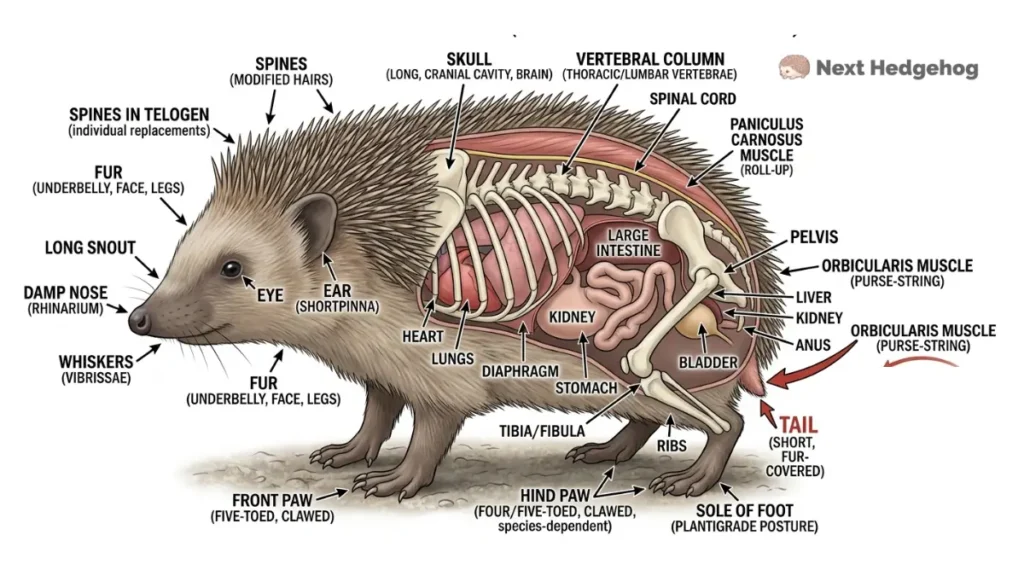
Hedgehog anatomy is simple but very unique. These small mammals are designed for survival in the wild. Their body is covered with sharp spines that protect them from predators. Under those spines they have a soft body structure that includes legs, ears, eyes, snout, and a very small tail.
Their shape helps them curl into a tight ball when they feel danger. This makes the spines face outward and protects the soft parts inside. Every part of their body works together to support this defense behavior.
Important aspects of hedgehog anatomy:
- Covered with sharp protective spines instead of fur on the back
- Small hidden tail that is often not visible
- Short legs built for walking and digging
- Pointed snout used for smelling food and exploring
- Small eyes adapted for low light vision
- Rounded body shape that allows curling into a ball
- Strong sense of smell and hearing compared to vision
Read Also: Do Hedgehogs Have Ears
Do Hedgehogs Really Have Tails?
Yes hedgehogs really do have tails. The surprising part is that their tails are extremely small. In many cases the tail is so short that people do not notice it at all. This is why many assume hedgehogs have no tail.
A hedgehog’s tail is hidden under its spines and fur. It usually looks like a small stub at the back of the body. In some species it is only a few millimeters long. Because of its size and position it is very easy to miss during casual observation.
Even though it is small the tail is still a real body part. It is connected to the spine and works as part of the hedgehog’s natural structure. It may not be useful for grabbing or climbing like some animals but it still has a biological role.
Why Their Tails Are So Hard to Notice?
Hedgehog tails are hard to notice mainly because of their size and position. They are extremely short compared to the rest of the body. In many hedgehog species the tail is almost hidden completely under the fur and spines. This makes it blend into the body shape.
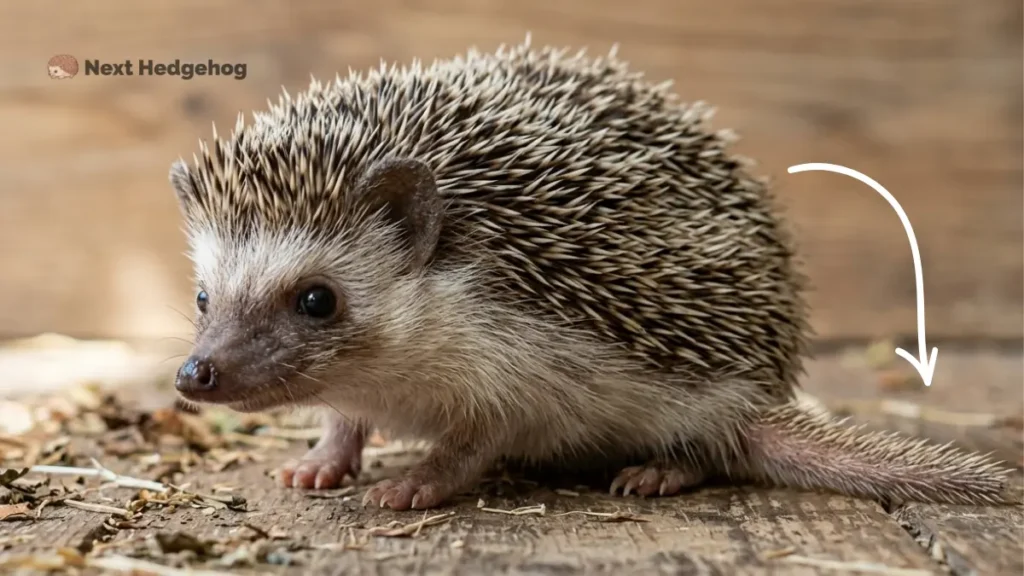
Another reason is the dense layer of spines on their back. These spines cover the area where the tail begins. So even when you look closely it is difficult to separate the tail from the rest of the body. It does not stand out in any visible way.
Their natural posture also hides the tail. Hedgehogs often curl their body or keep low to the ground when moving. In these positions the tail becomes even less visible. It stays pressed close to the body and does not move much.
Key reasons it is hard to notice:
- Very small size compared to body
- Hidden under spines and fur
- No distinct color or shape difference
- Often covered when hedgehog curls or moves
- Located close to the body base
Read Also: Do Hedgehogs Have Whiskers
Hedgehog Tail Size and Appearance
Hedgehog tail size is very small even from birth. It does not grow into a long tail like many other mammals. Instead it stays short throughout the hedgehog’s life. The difference between ages is only a few millimeters.
In general younger hedgehogs have a slightly less noticeable tail because their body is smaller overall. As they grow the tail does not grow much in proportion, so it still looks like a tiny stub in adults.
| Age Stage | Approximate Tail Length | Appearance Description |
|---|---|---|
| Newborn (0–1 week) | 2–4 mm | Very tiny and almost invisible under skin and fur |
| Juvenile (2–6 weeks) | 3–6 mm | Slightly more visible but still hidden under spines |
| Young adult (2–6 months) | 5–10 mm | Small stub shape, noticeable only on close look |
| Adult (6+ months) | 5–15 mm | Remains short, blends with body and spines |
Purpose of a Hedgehog’s Tail
A hedgehog’s tail may look tiny and almost useless at first glance. But it still serves important roles in the body. Even though it is not large or noticeable it is part of the hedgehog’s natural structure. It supports movement balance and basic biological functions in subtle ways.
Balance and Movement
The tail helps the hedgehog maintain balance while walking or climbing small surfaces. Since hedgehogs have a rounded body and short legs they need extra support when moving on uneven ground. The tail acts like a small stabilizer that helps them stay steady during motion.
Support for Body Alignment
The tail plays a small role in keeping the spine and lower body aligned. It works as a natural extension of the backbone. While it does not carry weight or perform strong actions it contributes to overall body structure and posture.
Role in Natural Functions
Even though it is very small the tail contains nerves and blood supply like other body parts. It supports basic biological functions in the lower body area. It also helps complete the natural anatomy of hedgehogs in a way that supports healthy development.
Limited Role in Communication
Unlike animals with expressive tails hedgehogs do not use their tail for communication. However it may move slightly when the body shifts or when the hedgehog reacts to stress or comfort. These movements are minimal but still part of their natural behavior.
Why People Think Hedgehogs Don’t Have Tails?

Many people get confused about hedgehogs because their tail is almost invisible. This leads to a common belief that hedgehogs do not have tails. In reality the tail exists but it is hidden and very small. Here are the main reasons behind this confusion.
- Extremely small tail size: The hedgehog tail is only a few millimeters long in most cases. Because of this tiny size it does not stand out from the body and is very easy to miss during normal observation.
- Hidden under spines and fur: The back of a hedgehog is covered with dense spines. These spines and surrounding fur completely cover the tail area which makes it almost invisible.
- Blends with body color and texture: The tail does not have a different color or shape. It matches the body tone so it blends naturally and does not look like a separate part.
- Close position to the body: The tail is attached very close to the lower back. There is no clear gap or separation which makes it hard to identify as a distinct feature.
- Curling behavior hides it completely: When hedgehogs feel unsafe they curl into a tight ball. In this position the tail is fully covered and cannot be seen at all.
- No obvious movement or function: Unlike some animals that wag or move their tails, hedgehogs do not show visible tail movement. This makes people assume there is no tail.
- Poor visibility in photos and videos: Most images and quick videos focus on the face or spines. The tail area is rarely highlighted which strengthens the misunderstanding.
Interesting Facts About Hedgehog Tails
Hedgehog tails are small but still full of interesting details. Even though they are often ignored or unnoticed, they are part of the hedgehog’s unique body design. Here are some simple and surprising facts about them.
- Hedgehog tails are usually only a few millimeters to about 1.5 cm long depending on species and age. This makes them one of the shortest tails among mammals.
- The tail is present in all hedgehog species but it is often hidden under spines and fur, so most people never see it clearly.
- Baby hedgehogs already have a tail at birth, but it is so small that it almost looks like a natural part of the body.
- The tail does not grow much as the hedgehog ages, so adults still have very short tails compared to their body size.
- It contains normal skin, bones, and nerves like other body parts, even though it looks simple and minimal.
- Hedgehogs do not use their tails for grabbing objects, climbing, or communication like some other animals.
- The tail is more visible in some African pygmy hedgehogs than in European hedgehogs, but it is still very short in both.
- In most natural sightings, the tail is one of the last features people notice because it blends completely with the body structure.
- Even veterinarians sometimes need a close look to properly observe the tail due to its hidden position.
- Despite its tiny size, the tail is still an important part of the hedgehog’s complete anatomy.
FAQs and Answers
Hedgehog tails may look simple but they often raise many questions. Most people are surprised when they learn how small they really are. In this section we answer some of the most common questions about hedgehog tails in a clear and easy way.
Do hedgehogs have long tails?
No hedgehogs do not have long tails. Their tails are very short and usually only a few millimeters to about 1.5 cm long depending on the species. It stays hidden under spines and fur so it never looks long or noticeable.
Do baby hedgehogs have tails?
Yes baby hedgehogs are born with tails. The tail is already present at birth but it is extremely small. As they grow the tail does not grow much so it remains tiny throughout their life.
Can you see a hedgehog’s tail easily?
No it is very hard to see a hedgehog’s tail. It is hidden under spines and fur and blends with the body. Most people only notice it if they look very closely or gently examine the lower back area.
Does the tail help hedgehogs climb?
Not really. Hedgehogs do not use their tails for climbing. Their tail is too small to provide grip or support. They mainly rely on their legs and body balance for movement and climbing small surfaces.
Are hedgehog tails useful in survival?
The tail has a very limited role in survival. It does not help in defense or hunting. However it is still part of their anatomy and may support basic body balance and structure in a small way.