9+ Hedgehog Illegal States in US (with 5+ Other Countries)
Owning a hedgehog might sound harmless—they’re small, quiet, and undeniably cute. But legally? It’s more complicated than most people expect. Hedgehogs fall into the category of exotic animals, and that means laws vary widely depending on where you live.
If you’re planning to own one (or already do), understanding where hedgehogs are illegal isn’t optional—it’s essential. Let’s break it down clearly, with a law-focused lens so you don’t accidentally end up on the wrong side of regulations.
This guide breaks down hedgehog illegal states in the U.S. and key laws in other countries, so you can understand exactly where ownership is restricted—and more importantly, why.
Why Are Hedgehogs Illegal in Some U.S. States & Other Countries?
Hedgehog bans aren’t arbitrary—they’re rooted in environmental law, public safety policy, and how governments classify exotic animals. While they may seem harmless as pets, regulators look at the bigger picture beyond individual ownership.
Environmental Protection & Invasive Species Risk
One of the biggest legal concerns is the possibility of hedgehogs becoming invasive species. If released or escaped, they could:
- Compete with native wildlife for food
- Disrupt local ecosystems
- Reproduce and establish wild populations
Regions with fragile ecosystems—especially islands or areas with unique biodiversity—tend to enforce strict bans to prevent long-term ecological damage.
Public Health & Disease Concerns
Hedgehogs can carry diseases that are transmissible to humans, particularly:
- Salmonella
- Ringworm
Because of this, some jurisdictions classify them under animals that pose public health risks, especially in densely populated areas where exposure could spread more easily.
Exotic Animal Classification Laws
In many places, hedgehogs are legally categorized as exotic or non-native animals. This classification automatically triggers restrictions such as:
- Full ownership bans
- Permit requirements
- Import/export controls
Even though domesticated species like African pygmy hedgehogs are common in the pet trade, the law often doesn’t differentiate clearly between wild and domesticated varieties.
Agricultural & Wildlife Protection Policies
Some governments are concerned about hedgehogs affecting:
- Crops and farming systems
- Native insects and small animals
- Ground-nesting birds
To protect agriculture and biodiversity, laws are written broadly to restrict non-native species—including hedgehogs.
Local Government Authority & City-Level Bans
In the U.S., laws don’t stop at the state level. Cities and counties can create their own rules. That’s why a hedgehog might be:
- Legal in a state
- Illegal in a specific city within that state
This layered legal system often causes confusion for pet owners.
What the Law Says?
Hedgehog ownership is regulated through a mix of state wildlife laws, federal import rules, and local ordinances. Legally, hedgehogs are usually classified as exotic or non-native animals, which means they are subject to stricter controls than typical household pets.
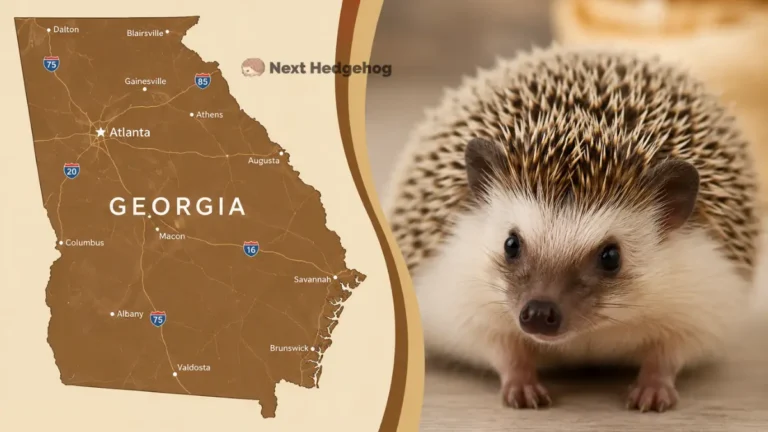
At the state level, some laws clearly ban hedgehogs. For example, in California, they are prohibited under the California Code of Regulations, Title 14, Section 4700, which restricts certain non-native species to protect the environment. In Georgia, wildlife regulations broadly classify insectivores (including hedgehogs) as animals that cannot be kept as pets without special authorization.
Other states use permit systems instead of outright bans. In Pennsylvania, for instance, ownership falls under Exotic Wildlife Possession Permit laws (34 Pa.C.S.A. §§ 2961–2963), making it highly regulated and difficult without proper approval.
At the federal level, there is no complete ban, but agencies like the USDA APHIS (Animal and Plant Health Inspection Service) regulate the import of hedgehogs for disease control. Even if federal rules allow import, state and local laws still determine whether you can legally own one.
US States Where Hedgehogs Are Illegal
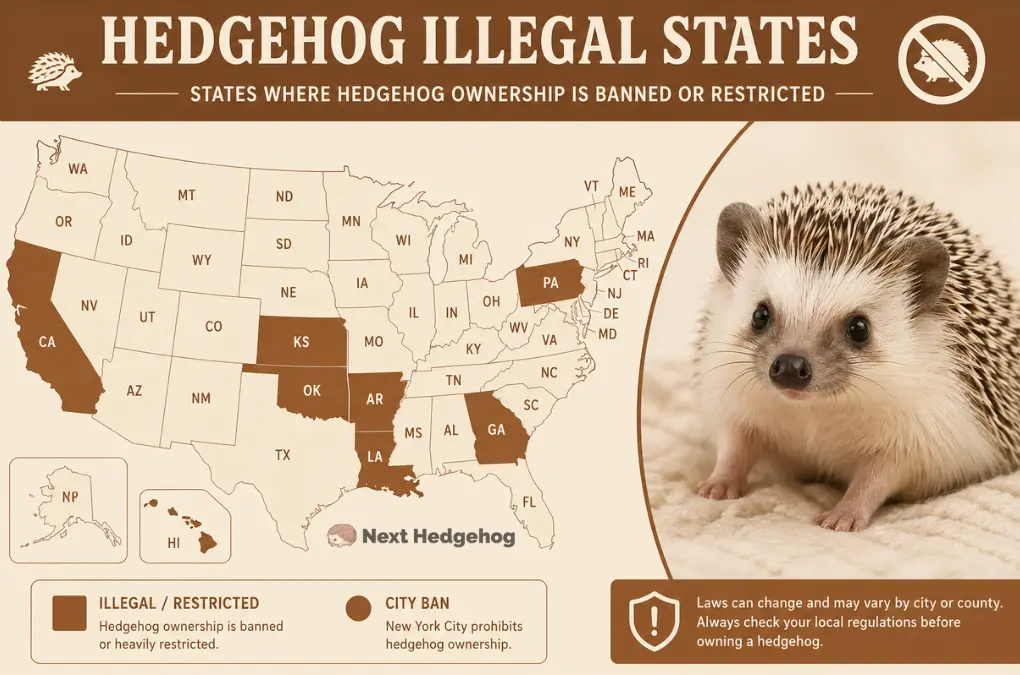
Hedgehog ownership in the U.S. isn’t universally allowed. While many states permit them, a handful enforce strict bans due to environmental, wildlife, or public health laws. Below are the key places where owning a hedgehog is illegal or effectively prohibited:
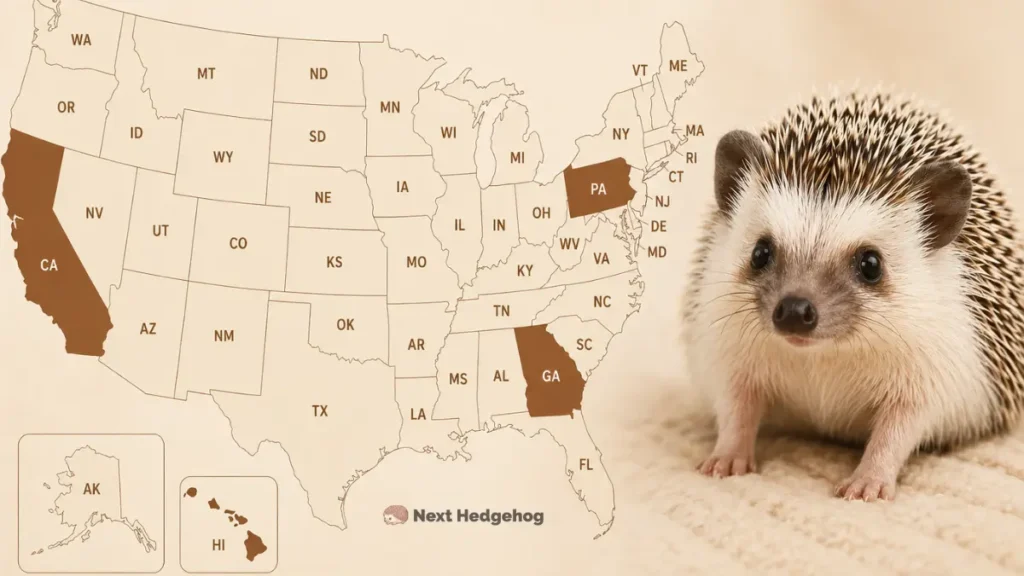
- California – Hedgehogs are banned under state wildlife laws (Title 14, Section 4700) to prevent non-native species from disrupting local ecosystems.
- Hawaii – Due to its fragile island ecosystem, Hawaii enforces strict bans on exotic animals, including hedgehogs, to avoid invasive species risks.
- Georgia – State regulations classify hedgehogs under restricted exotic animals, making private ownership illegal without special authorization.
- Pennsylvania – Hedgehogs fall under exotic wildlife laws, and while permits may exist, they are rarely granted for pet ownership, effectively making them illegal for most people.
- Washington D.C. – The district has strict exotic pet laws that prohibit hedgehog ownership entirely.
- New York City – Although hedgehogs are legal in New York State, NYC bans them under local health codes, making ownership illegal within city limits.
These restrictions highlight how hedgehog legality depends heavily on local laws, not just state-wide rules. Always verify your specific location before considering ownership.
States Where Hedgehogs Are Restricted or Require Permits
Not all states fully ban hedgehogs—some allow ownership but place them under strict regulations or permit systems. In these areas, you can legally own a hedgehog only if you meet specific legal requirements, which may include licenses, documentation, or inspections.
- New Jersey – Hedgehogs are legal but require an Exotic and Nongame Wildlife Permit issued by the state. Owners must comply with housing and care standards.
- Wisconsin – Ownership is generally allowed, but certain species or situations may require permits, especially when importing or breeding hedgehogs.
- Maine – Hedgehogs are permitted with restrictions under wildlife importation laws. In some cases, an import or possession permit may be required.
These states don’t outright prohibit hedgehogs, but they treat them as regulated exotic animals, meaning ownership comes with legal responsibilities. Always check the latest state guidelines before buying or transporting a hedgehog.
Countries Where Hedgehogs are Illegal
Hedgehog ownership isn’t just restricted in parts of the United States—several countries have strict national bans due to environmental protection, biosecurity laws, and wildlife conservation policies. In these places, owning, importing, or breeding hedgehogs is either completely illegal or heavily restricted.
- Australia – Hedgehogs are strictly prohibited under national biosecurity laws. The country has some of the toughest animal import rules in the world to prevent invasive species.
- New Zealand – While hedgehogs exist in the wild, regulations around ownership and control are strict, and they are often treated as pests rather than pets.
- Iceland – Hedgehogs are illegal to import or keep as pets due to environmental and disease control concerns.
- Singapore – Classified as exotic wildlife, hedgehogs are not allowed as pets under strict animal control laws.
- United Arab Emirates – Hedgehogs fall under restricted or prohibited exotic species depending on the emirate, with tight regulations on ownership and trade.
These countries enforce bans primarily to protect native ecosystems, agriculture, and public health. If you’re planning to travel or relocate internationally with a hedgehog, always check the destination country’s laws beforehand to avoid legal issues.
States & Countries Where Hedgehogs Are Legal
Hedgehog ownership is much more common in many parts of the world than people assume. While some regions strictly ban them, a large number of U.S. states and countries allow hedgehogs as pets with minimal or no restrictions.
In these places, they are generally considered legal exotic pets, although local city rules can still apply.
Top U.S. States Where Hedgehogs Are Legal
- Texas – One of the most hedgehog-friendly states. Ownership is legal statewide with no special permit required, making it a popular choice for exotic pet owners.
- Florida – Hedgehogs are legal and widely kept as pets. However, owners should still check local county rules for any additional restrictions.
- Ohio – Legal with no statewide ban. Ohio has relatively relaxed exotic pet laws compared to stricter states.
- Indiana – Hedgehogs are legal and commonly sold through breeders and pet owners.
- Michigan – Fully legal for ownership, making it another common state for hedgehog enthusiasts.
Top Countries Where Hedgehogs Are Legal
- United Kingdom – Hedgehogs are legal and even native species exist in the wild. However, wild hedgehogs are protected and cannot be taken from nature.
- Canada – Legal in most provinces, though some municipalities may impose local restrictions or licensing requirements.
- Japan – Hedgehogs are fully legal and extremely popular as exotic pets, especially African pygmy hedgehogs.
Why Laws Differ by State & Country
Hedgehog legality is not based on a single global standard. Instead, every state and country builds its own rules depending on local ecosystems, public health priorities, and wildlife management policies. That’s why a hedgehog can be a legal pet in one place and completely banned in another.
- Environmental protection policies: Some regions focus heavily on protecting native ecosystems. If an animal is considered a potential invasive species, it may be restricted or banned to prevent ecological imbalance.
- Invasive species risk: Laws differ based on how likely an animal is to survive, reproduce, and spread in the wild. Island nations and warmer climates often impose stricter bans due to higher ecological vulnerability.
- Public health and disease control: Governments regulate exotic animals that may carry diseases transferable to humans or livestock, leading to restrictions in certain areas.
- Wildlife classification systems: Each country or state defines animals differently—some classify hedgehogs as pets, while others categorize them as exotic wildlife or restricted species.
- Agricultural and economic protection: In some regions, exotic animals are restricted to protect farming industries, livestock, and native species that support local economies.
- Legal structure and government authority: In countries like the U.S., laws vary because states have independent wildlife control systems, meaning there is no single national rule for pet ownership.
- Biosecurity and import control laws: Some governments enforce strict import rules to prevent foreign species from entering and disrupting local biodiversity or spreading diseases.
Legal Risks of Owning a Hedgehog in Illegal States
Owning a hedgehog in a state where it is banned or restricted isn’t just a technical violation—it can lead to real legal consequences. Wildlife laws in many regions are enforced strictly, and penalties can escalate quickly depending on the jurisdiction and situation.
- Animal confiscation: Authorities can seize the hedgehog if it is found to be owned illegally. In many cases, the animal is not returned to the owner and may be relocated or euthanized depending on local policy.
- Fines and financial penalties: Illegal possession can result in monetary fines. These vary by state but can become significant, especially if the case is considered a repeated or intentional violation.
- Criminal or misdemeanor charges: In stricter states, owning a prohibited exotic animal may be treated as a misdemeanor offense, potentially resulting in a criminal record.
- Legal complications during inspections or complaints: Reports from neighbors or routine inspections can trigger investigations, especially if the animal is classified as restricted wildlife.
- Difficulty in rehoming or relocating the pet: If ownership becomes illegal due to moving states, finding legal placement for the hedgehog can be difficult and time-sensitive.
- Additional penalties for breeding or selling: Breeding or distributing hedgehogs in restricted areas often carries heavier penalties than simple ownership.
Penalties and Fines for Illegal Ownership
Owning a hedgehog in a state or country where it is banned is treated as a violation of wildlife or exotic animal laws, and penalties can vary widely depending on location and circumstances. In most cases, authorities focus on removing the animal, but financial and legal consequences can also apply—especially if the violation is intentional or repeated.
Below is a simplified breakdown of typical penalties across different regions:
| Region Type | Common Legal Outcome | Fine Range | Additional Consequences |
|---|---|---|---|
| Strict ban states (e.g., California, Hawaii) | Confiscation of animal + citation | $100 – $1,000+ | Possible misdemeanor charges, court appearance |
| Restricted states with permit systems | Warning or fine for missing permit | $50 – $500 | Requirement to rehome animal or obtain permit immediately |
| City-level bans (e.g., NYC) | Immediate confiscation | $100 – $300 | Local summons or violation record |
| Wildlife-sensitive countries (e.g., Australia) | Severe penalties or prosecution | $1,000 – $10,000+ | Criminal charges, biosecurity violations |
| General exotic pet violations | Case-by-case enforcement | Varies widely | Animal seizure, licensing restrictions |
How to Legally Own a Hedgehog?
Owning a hedgehog can be perfectly legal in many regions—but only if you follow the right legal steps. Because laws vary by state, city, and country, legal ownership is less about simply buying a pet and more about ensuring you comply with wildlife and exotic animal regulations from the start.
Here’s a clear, practical breakdown of how to do it the right way.
Step 1: Check Your Local Laws
Before anything else, confirm whether hedgehogs are legal where you live. Laws can differ between states and even cities.
- Check your state wildlife department website
- Review city or county animal control rules
- Look for “exotic pet” or “restricted species” lists
If hedgehogs are banned in your area, ownership is not legally possible—even if they are sold nearby.
Step 2: Understand Permit Requirements (If Applicable)
In some regions, hedgehogs are allowed but regulated.
- You may need an exotic pet permit
- Some areas require registration of the animal
- Others may require housing inspections or veterinary approval
Without proper permits, ownership can still be considered illegal.
Step 3: Buy Only From Licensed Breeders or Sellers
Legal ownership often depends on where you get the animal.
- Choose breeders who operate legally in your region
- Ask for proof of compliance with local wildlife laws
- Avoid unlicensed sellers or informal online listings
This helps ensure the hedgehog was not illegally transported or sold.
Step 4: Follow Import or Transport Rules
If you are bringing a hedgehog from another state or country:
- Check import restrictions and health certificates
- Follow USDA or local animal transport guidelines
- Ensure the destination allows possession before moving it
Transporting a hedgehog into a banned area can still be illegal, even if you legally bought it elsewhere.
Step 5: Comply With Ongoing Care Regulations
Some regulated areas require continued compliance:
- Proper enclosure standards
- Veterinary care records
- Periodic inspections (in rare cases)
Following these rules helps maintain legal ownership status.
Step 6: Stay Updated on Law Changes
Exotic pet laws can change over time.
- Monitor local wildlife authority updates
- Check for new bans or permit changes
- Reconfirm legality if you move to a new area
What Happens If You Move to an Illegal State With a Hedgehog?
Moving with a hedgehog might seem simple, but in legal terms it can quickly become complicated. In the U.S., animal laws are enforced at the state and sometimes city level, which means your pet’s legality can change the moment you cross state lines.
If hedgehogs are illegal in your new location, you may be required to take immediate action to comply with local wildlife laws.
- You may be required to remove the animal immediately: If hedgehogs are banned in your new state or city, authorities can require you to rehome or surrender the pet.
- Confiscation by wildlife or animal control officers: If discovered, the hedgehog may be seized by local authorities, especially in strict ban states.
- Possible fines or legal notices: Some regions issue fines for possession of prohibited exotic animals, even if you moved in with it unknowingly.
- No legal “grandfathering” in many cases: Most states do not allow you to keep a previously owned hedgehog once you become a resident, even if you legally owned it elsewhere.
- Temporary grace periods in rare situations: A few jurisdictions may offer short relocation windows to rehome the animal, but this is not guaranteed.
- Difficulty finding legal rehoming options: In illegal states, finding someone legally allowed to take ownership can be challenging.
- Risk increases if you report or register your address change: Updating residency details or pet records can trigger compliance checks depending on local enforcement.
Alternatives to Hedgehogs in Illegal States
If hedgehogs are illegal where you live, the good news is you still have several small, low-maintenance pets that offer a similar experience in terms of personality, size, and care level.
These alternatives are widely legal in most places, making them safer options for exotic pet lovers who want something unique but compliant with local laws.
- Hamster: Hamsters are one of the closest alternatives in terms of size and care. They are small, nocturnal, and easy to maintain in compact enclosures, making them a popular substitute for hedgehog enthusiasts.
- Gerbil: Gerbils are social, active, and easy to care for. Unlike hedgehogs, they prefer companionship and are great for owners who enjoy observing playful behavior.
- Guinea pig: Guinea pigs are gentle, friendly, and interactive pets. While slightly larger than hedgehogs, they are excellent for people who want a calm, handling-friendly companion.
- Chinchilla: Chinchillas are soft, quiet, and nocturnal like hedgehogs. They require a bit more care but offer a unique and affectionate pet experience.
- Fancy rat: Fancy rats are highly intelligent and social. They bond strongly with owners and are often considered one of the most interactive small pets available.